
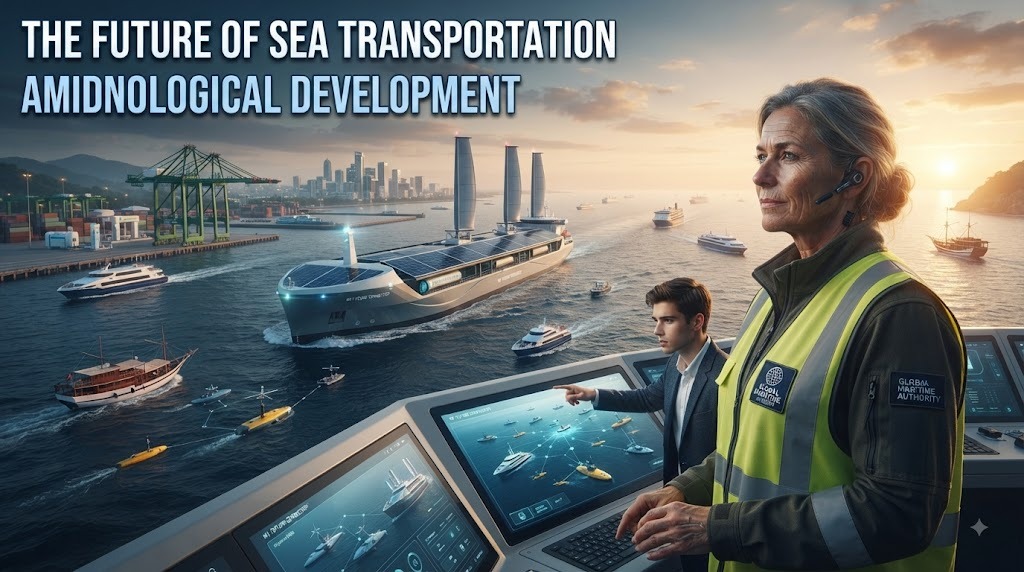
Sea transportation has played an important role in connecting countries, moving goods, and supporting international trade for centuries. Today, the maritime industry is entering a new period shaped by rapid technological development. Digital systems, automation, artificial intelligence, cleaner energy, and advanced navigation are changing how ships and ports operate. The future of sea transportation will depend on how effectively these technologies can improve efficiency, safety, sustainability, and connectivity. These changes are expected to create a maritime transportation system that is more intelligent and responsive to global needs.
Technological development does not mean that traditional maritime operations will disappear immediately. Instead, new technologies will gradually be combined with existing systems and human expertise. Shipping companies, ports, governments, and maritime workers will need to adapt to these changes. Investment in infrastructure and workforce training will also become increasingly important. With proper planning, technology can help create a more efficient, safe, and environmentally responsible maritime sector.
THE ROLE OF TECHNOLOGY IN SEA TRANSPORTATION
Technology is becoming an essential part of modern maritime transportation. Ships can now use advanced navigation systems, sensors, communication networks, and digital monitoring tools to improve operations. Maritime technology can help crews and shipping companies make better decisions based on real-time information. These systems can also reduce unnecessary fuel consumption and operational delays.
Ports are also adopting technology to improve cargo handling and vessel management. Digital platforms can connect shipping companies, port operators, customs authorities, and logistics providers. Better information sharing can reduce paperwork and improve coordination. As technology continues to develop, maritime transportation will become increasingly dependent on accurate and timely data.
SMART SHIPPING SYSTEMS
Smart shipping refers to the use of digital technologies to make maritime operations more efficient and connected. Sensors can collect information about fuel consumption, engine performance, weather, vessel speed, and cargo conditions. Smart shipping systems can analyze this information and support better operational decisions. This can help reduce fuel use, maintenance costs, and unexpected disruptions.
Artificial intelligence can also be used to identify patterns and predict potential operational problems. For example, predictive systems can detect unusual engine behavior before a major failure occurs. Digital route planning can recommend efficient routes based on weather, traffic, and vessel conditions. These technologies can improve performance while allowing crews and shore-based teams to respond more quickly to changes.
ARTIFICIAL INTELLIGENCE IN MARITIME OPERATIONS
Artificial intelligence has significant potential to transform sea transportation. AI systems can process large amounts of information from vessels, ports, weather services, and logistics networks. Artificial intelligence can support route optimization, predictive maintenance, cargo planning, and risk assessment. These applications can help maritime operators make faster and more informed decisions.
AI is not necessarily intended to replace maritime professionals. Instead, it can provide additional information that helps crews and managers perform their responsibilities more effectively. Human judgment remains important, particularly when dealing with unexpected weather, equipment failures, or safety situations. The combination of experienced workers and intelligent systems can improve overall maritime performance.
AUTONOMOUS AND REMOTELY OPERATED VESSELS
Autonomous vessels are among the most advanced developments in maritime technology. These vessels use sensors, navigation systems, communication networks, and automated decision-making tools to perform some operations with limited human intervention. Autonomous ships could potentially improve operational efficiency and reduce certain risks associated with human error. However, fully autonomous ocean-going vessels still face significant technical, regulatory, safety, and economic challenges.
Remote operation centers may also become more common for certain maritime activities. Shore-based operators can monitor vessel conditions and support navigation from a distance. Such systems require reliable communication and strong cybersecurity protection. Regulations must also clearly define responsibility when automated systems are involved. The development of autonomous shipping is therefore likely to be gradual.
DIGITAL NAVIGATION AND ROUTE OPTIMIZATION
Navigation technology is becoming more advanced and accurate. Modern vessels can combine satellite positioning, electronic charts, radar, weather information, and other data sources. Digital navigation helps crews understand their surroundings and make better route decisions. It can also support safer operations in areas with heavy vessel traffic or difficult geographical conditions.
Route optimization can reduce unnecessary travel distance and fuel consumption. Systems can consider weather conditions, sea currents, traffic, port schedules, and vessel characteristics when recommending routes. However, automated recommendations should always be evaluated by qualified maritime professionals. Technology can support navigation, but safety must remain the primary consideration.
CLEANER FUELS AND PROPULSION TECHNOLOGY
Environmental concerns are encouraging the maritime industry to explore cleaner energy sources. Traditional marine fuels can produce greenhouse gas emissions and other pollutants. Alternative fuels such as methanol, biofuels, hydrogen, and ammonia are being considered for different maritime applications. The suitability of each fuel depends on vessel type, route, availability, infrastructure, cost, and safety requirements.
Electric and hybrid propulsion systems may become increasingly useful for shorter routes and certain passenger vessels. Battery technology continues to develop, although energy density remains a challenge for long-distance shipping. Cleaner propulsion can reduce emissions when supported by low-carbon energy sources. The future maritime energy system will likely involve several technologies rather than one universal fuel.
RENEWABLE ENERGY FOR SHIPS
Renewable energy can complement other propulsion technologies in future shipping. Solar panels can generate electricity for selected onboard systems, while wind-assisted propulsion can provide additional thrust. Renewable maritime energy can reduce fuel consumption when applied under suitable operating conditions. These technologies are particularly useful when integrated with efficient vessel designs.
Modern wind-assisted systems can include rotor sails and other aerodynamic technologies. Their effectiveness depends on wind conditions, route characteristics, and vessel design. Solar power may also support lighting, communication, monitoring, and auxiliary equipment. Renewable energy is unlikely to replace all marine fuels immediately, but it can contribute to a broader strategy for reducing emissions.
GREEN AND SMART PORTS
The future of sea transportation depends not only on ships but also on ports. Modern ports are becoming more automated, connected, and environmentally responsible. Smart ports can use digital systems to manage vessels, cargo, traffic, energy, and infrastructure. Better coordination can reduce waiting times and improve cargo movement.
Green ports can also use renewable electricity, electric equipment, efficient lighting, and improved waste management. Shore power can allow compatible vessels to use electricity while docked instead of running certain onboard engines. Automated cargo-handling equipment can improve productivity. The combination of smart technology and environmental practices can make ports important centers of sustainable maritime transportation.
AUTOMATION IN CARGO HANDLING
Cargo handling is a major part of maritime operations. Delays in loading and unloading can increase vessel turnaround times and affect supply chains. Port automation can use automated cranes, sensors, robotics, and digital scheduling systems to improve cargo movement. These technologies can increase consistency and reduce certain repetitive tasks.
Automation does not eliminate the need for human workers. Instead, workers may move toward roles involving system management, maintenance, supervision, and data analysis. Training will therefore become important as port operations become more automated. Well-designed automation can improve productivity while maintaining appropriate human oversight.
IMPROVING MARITIME SAFETY
Technology can provide new tools for improving safety at sea. Advanced sensors, digital navigation, weather forecasting, communication systems, and automated alerts can help crews identify risks earlier. Maritime safety technology can reduce the likelihood of accidents caused by poor information or delayed responses. However, technology must be used correctly and maintained properly.
Human oversight remains essential for safe maritime operations. Crews must understand the limitations of digital systems and be prepared to take control when necessary. Regular drills and training can improve emergency preparedness. Technology should support established safety procedures rather than encourage excessive reliance on automation.
TECHNOLOGY AND ENVIRONMENTAL SUSTAINABILITY
Technological development can help reduce the environmental impact of maritime transportation. More efficient engines, alternative fuels, optimized routes, and digital monitoring can reduce fuel consumption. Sustainable shipping technology can also help minimize air pollution and greenhouse gas emissions. These improvements are increasingly important as environmental standards become stricter.
Digital systems can identify areas where energy is being wasted. Smart ports can reduce emissions by optimizing vessel movements and using cleaner equipment. Renewable energy can also support port and vessel operations. Technology alone cannot solve every environmental problem, but it can provide important tools for reducing maritime impacts.
CHALLENGES OF TECHNOLOGICAL DEVELOPMENT
Although technology offers many benefits, its implementation also creates challenges. Advanced vessels, digital infrastructure, and automated port equipment can require substantial investment. Technology adoption challenges may be especially significant for smaller shipping companies and ports with limited financial resources. Differences in technical standards can also make it difficult to connect systems across organizations.
Cybersecurity, workforce training, regulation, and data management are additional concerns. New technologies must be tested carefully to ensure that they meet maritime safety requirements. Governments and industry organizations need to establish appropriate standards and regulations. A gradual approach can allow companies to adopt technology while managing financial and operational risks.
THE FUTURE OF MARITIME TRANSPORTATION
The future of sea transportation will likely be shaped by a combination of digitalization, automation, cleaner energy, and advanced data systems. Future maritime transportation may involve smarter vessels that communicate continuously with ports and shore-based operations. Ships could optimize their routes, fuel use, and maintenance based on real-time information. Ports could become highly connected logistics centers that coordinate cargo and vessel movements automatically.
However, the maritime industry will continue to depend on human expertise. Technology should improve decision-making rather than eliminate responsible human oversight. International cooperation will be important because ships frequently cross national borders and operate under different regulatory systems. Investment in infrastructure and education will also determine how quickly new technologies can be adopted. The most successful maritime systems will combine innovation with safety, sustainability, and practical human expertise.
CONCLUSION
The future of sea transportation will be strongly influenced by technological development. Artificial intelligence, smart shipping, autonomous systems, digital navigation, alternative fuels, renewable energy, automation, big data, and smart ports can transform maritime operations. These technologies can improve efficiency, safety, environmental performance, and supply chain reliability.
However, technological progress must be supported by skilled workers, strong cybersecurity, suitable infrastructure, clear regulations, and responsible investment. Not every technology will be appropriate for every vessel or route, so implementation should consider technical and economic conditions. With balanced planning and continuous innovation, sea transportation can become smarter, safer, cleaner, and more efficient in the future.